U.S. container ports processed an average of 68,000 TEUs per day in 2009, according to the Bureau of Transportation Statistics. That scale helps explain why an international shipment is not a journey from seller to doorstep alone. Your parcel moves through transport networks, customs checks and delivery handovers, each with its own responsibilities.
For football shirt buyers, the useful questions are practical. When will the jersey arrive, what will it cost after import charges, and who will ask for payment? Understanding landed cost, the full cost of getting an order into your hands, matters just as much as choosing a fast service.
Table of Contents
- How Long International Shipping to the USA Really Takes
- What You Will Owe in Duties, Taxes and Fees
- How to Write a Customs Declaration That Clears Fast
- Choosing a Service by Parcel Size and Value
- Packing and Labeling Habits That Speed Up Delivery
- Tracking Gaps and What to Do When a Parcel Stalls
- Confirm Costs and Order Dates Before You Buy
How Long International Shipping to the USA Really Takes
International delivery times vary by service and route. Survey results offer useful context, while a seller's shipping range is a separate estimate, not a guarantee.
Typical transit times by shipping option
| Shipping option | Typical transit | Best for | Watch for |
|---|---|---|---|
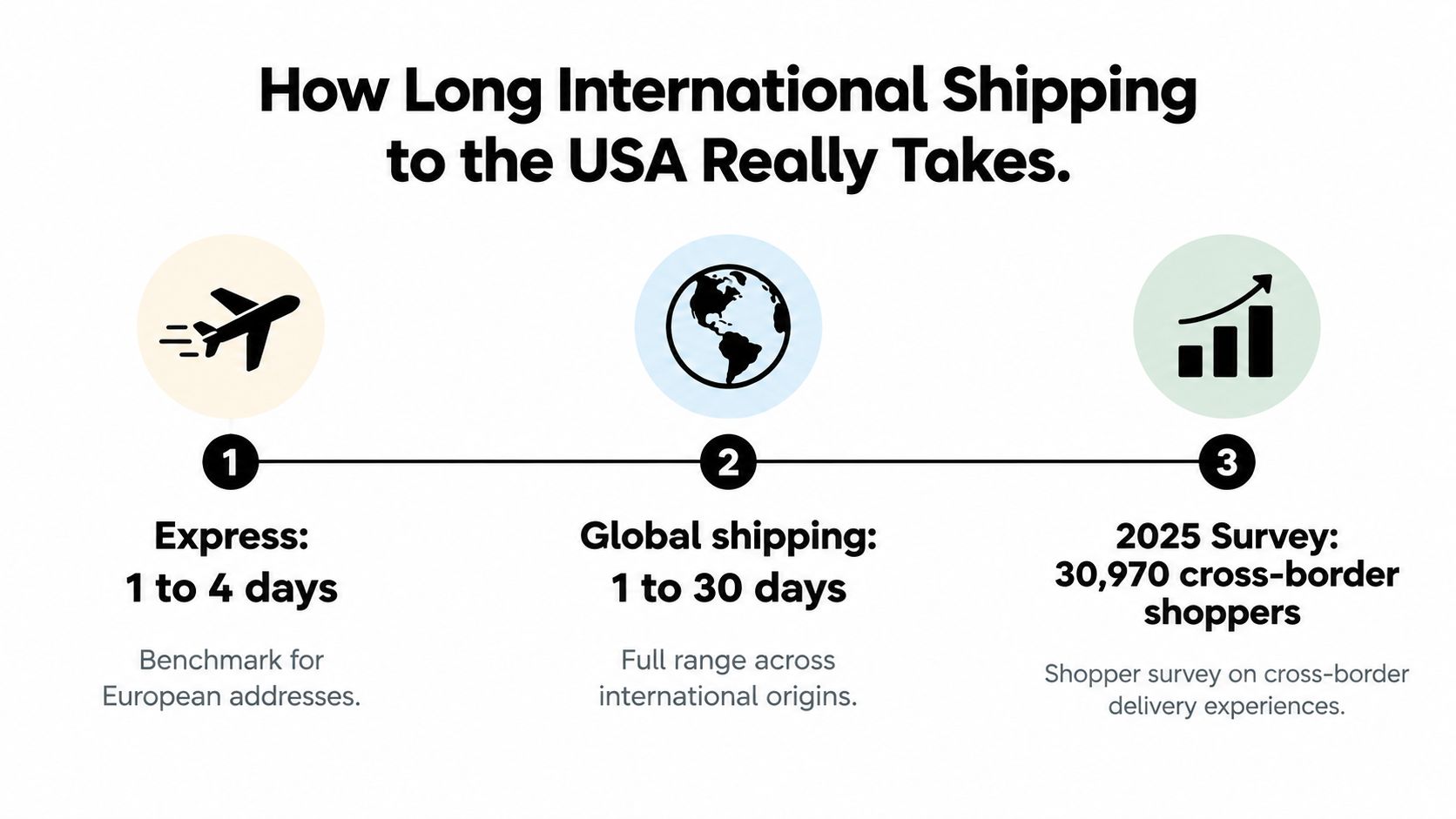
| Express delivery within Europe | 1–4 days for Mystershirt's European express delivery | Benchmark for European addresses | Not a U.S. import timeline |
| Global shipping to the USA | 1–30 days, an advertised global range | Orders with a flexible date | Customs review and the route can extend delivery |
| Typical cross-border parcel in the shopper survey | 4–5 days (19% of respondents) or 10–14 days (20%) | Planning context, not a service guarantee | Survey results cover cross-border shopping, not a U.S.-specific delivery promise |
| Express courier with customs cleared | Use the carrier's quoted remaining delivery window | Urgent gifts with a fixed date | Confirm the quote covers the destination |
The 2025 International Post Corporation survey covered 30,970 cross-border shoppers in 37 countries. The most commonly reported durations were 4–5 days for 19% of respondents and 10–14 days for 20%. These figures describe shoppers' international delivery experiences. They are not a promised transit time for a parcel entering the USA.
The infographic shows shipping stages and broad delivery ranges, including a 1–30 day global range. Use it as general context, rather than as a survey-backed delivery commitment for a particular U.S. address.
Separate dispatch time from transit time
An order confirmation means the retailer received your order. It does not necessarily mean the carrier has collected the parcel. Picking, preparation, packing and collection happen before the export scan.
After export, the shipment still needs to pass through customs, move to a domestic delivery network and reach the final address. A fast flight can be followed by a wait for document review or a local handover. Customs inspection can also delay delivery.
Distance is only one part of the estimate. Weekends, holidays, the postal or courier network, and whether the address is complete can all affect timing. Tracking can leave gaps, too. If updates stop after export, the parcel may still be moving through a stage with limited final-mile tracking.
Planning rule: Express changes the transport service you buy. It does not prevent customs from inspecting a shipment.
For a gift with a fixed arrival date, compare express options quoted for the U.S. destination, rather than using a European delivery estimate. The guide to how international express shipping works explains the service distinction. Count backward from the quoted delivery window to set an order deadline, leaving room for preparation and possible delays.
What You Will Owe in Duties, Taxes and Fees
A low item price does not guarantee a low landed cost. U.S. Customs and Border Protection states that, effective August 29, 2025, goods valued at or below US$800 generally no longer receive duty-free de minimis treatment, including goods arriving through international mail.
Shipping pays for transportation. Import charges may apply because the goods enter the USA, and paying for delivery does not necessarily mean customs charges have been prepaid.
Import charges on a parcel entering the USA
| Charge | How it is calculated | Amount or status |
|---|---|---|
| Ad valorem duty | Percentage of customs value, determined by applicable origin and product rules | Confirm the applicable rate before purchase |
| Transitional postal specific duty | Flat amount per item under the transitional postal arrangement | Rate changes in stages over time |
| De minimis exemption | Former low-value duty-free treatment | Generally unavailable under the change described above |
| Carrier or postal handling fee | Carrier's charge for applicable clearance or payment services | Ask whether it's included or billed separately |
CBP's transitional postal specific duty is charged per item at a rate that changes in stages over time, so confirm the rate in effect when the parcel enters the USA. The previously described range was US$80 to US$200 per item. It is a transitional postal assessment, not a permanent tariff, and should not be treated as the current rate without checking.
When the charge exceeds the shirt's price
Consider a hypothetical budget jersey priced below the lowest transitional specific charge. If that charge applied, the duty alone would exceed the shirt's price, before shipping or carrier fees. The landed total can therefore be much higher than the product price.
For a Premium shirt assessed under an ad valorem method, the calculation instead starts with the applicable customs value and confirmed tariff rate. Ask for the product's tariff classification and manufacturing origin. The country where a retailer dispatches the parcel does not, by itself, establish its origin for customs purposes.
Budget warning: Duties can exceed the item price. Compare the amount payable at your door, not just the amount beside the product photograph.
Before paying, find out whether duties are included, collected before release or requested on arrival. Also ask which carrier or postal operator collects them and whether handling charges are separate. This guide to import tax on clothing can help frame the questions, but the order's delivery terms determine who pays.
How to Write a Customs Declaration That Clears Fast
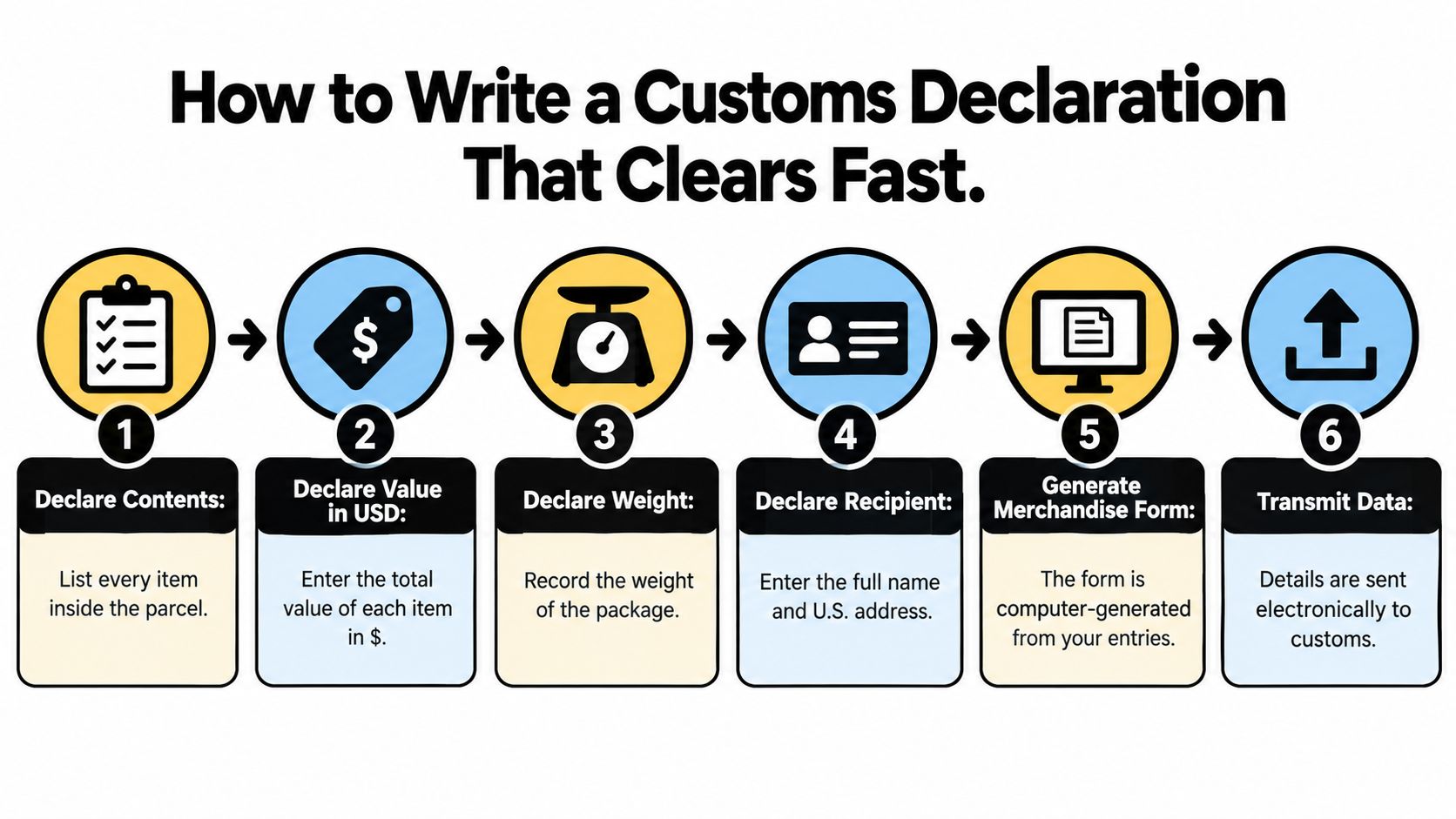
A customs declaration is a data-quality control, not decorative paperwork. The USPS international shipment preparation guide requires contents, value, weight and recipient details; merchandise forms generally must be computer-generated, with approved software transmitting declaration data electronically to customs.
Accurate information helps prevent avoidable questions, though it can't guarantee immediate clearance. The sender should check the shipment record before generating the label.
Build the declaration from the order
- Name the goods precisely. Use authentic football jersey when that accurately describes the item, rather than a broad description such as clothing. Include relevant material or product details needed for classification so customs doesn't have to request clarification.
- Enter each quantity. Record the number of garments on every line. A mystery-box product name alone doesn't tell customs what's inside.
- Match the transaction value. Use values that reconcile with the invoice and payment record. Don't reduce the value to make a shipment appear less expensive or describe a purchase as a gift just because the buyer intends to give it away.
- Itemize mystery-box contents. Represent each garment or appropriate category transparently. Line-item values should add up to the declared merchandise total, preventing unexplained valuation differences.
- Generate the form from structured fields. Carry product, weight and recipient data into the shipping software rather than retyping from memory. Check the complete recipient name and address before transmitting, because an electronic error can travel through the whole process.
- Screen the contents before dispatch. Check the destination's prohibited- and restricted-item rules. This prevents an otherwise well-documented parcel from being rejected because its contents aren't admissible.
The infographic summarizes the declaration fields and electronic submission process.
For a Sharing Box, the reconciliation might show an adult jersey, a retro jersey and a kids' jersey as separate entries, each with its quantity and allocated transaction value. The sum must match the merchandise total on the order record.
For more context on what happens after submission, consult the customs clearance process guide. Buyers should preserve their invoice; senders should preserve the transmitted declaration.
Choosing a Service by Parcel Size and Value
USPS First-Class Package International limits
The USPS First-Class Package International Service specification sets the following weight, value and dimensional limits.
| Limit | USPS limit | What it means for a shirt order |
|---|---|---|
| Maximum weight | 4 lb packed | Weigh the shirt together with all packaging and extras |
| Maximum declared value | US$400 | A collectible or larger bundle may need another service |
| Maximum length | 24 inches | Measure the closed box, not the folded garment |
| Length plus height plus thickness | 36 inches | Check the combined finished dimensions |
| Destination restrictions | Set by the destination country | Passing size checks doesn't establish admissibility |
These are limits for a USPS outbound international service, not a universal service specification for parcels sent from overseas to the USA. A foreign retailer must use its originating carrier's rules when selecting an inbound U.S. service.
That distinction prevents a common mistake: assuming that because the final delivery might involve USPS, an overseas parcel qualifies for a USPS service sold to U.S. senders.
Use a pass-or-fail routing test
For an eligible outbound shipment, every applicable condition must pass. If packed weight, declared value or dimensions exceed the service specification, select a service designed for the shipment instead of trying to squeeze it into the cheaper category.
A compact jersey parcel and a Sharing Box shouldn't automatically receive the same routing. Signed merchandise may require a higher-value service even when the physical parcel is small. Destination restrictions remain a separate condition, covered by the contents check.
Before saving checkout specifications, pack representative Premium, Retro, Kids and sharing-box configurations using the protective habits below. Weigh and measure the finished parcels, then store those measurements against the correct product configuration.
Address type deserves attention too, particularly for buyers using forwarding services. Cloud Residents' explanation of why banks reject expat mailing addresses helps distinguish mailing addresses from residential-address requirements. Banking acceptance and carrier deliverability are different questions, so confirm parcel acceptance with the forwarding provider rather than assuming either establishes the other.
A usable service must fit the parcel, accept its value and reach the actual delivery address.
Packing and Labeling Habits That Speed Up Delivery
Good packing doesn't make an aircraft faster. It reduces avoidable problems: damaged printing, unreadable addresses, opened seams and parcels that no longer match the shipping specification.
Use a digital scale, a measuring tape and a clear printed label. Check the parcel in its finished state, not while the shirt is still lying beside the box.
Prepare the parcel for repeated handling
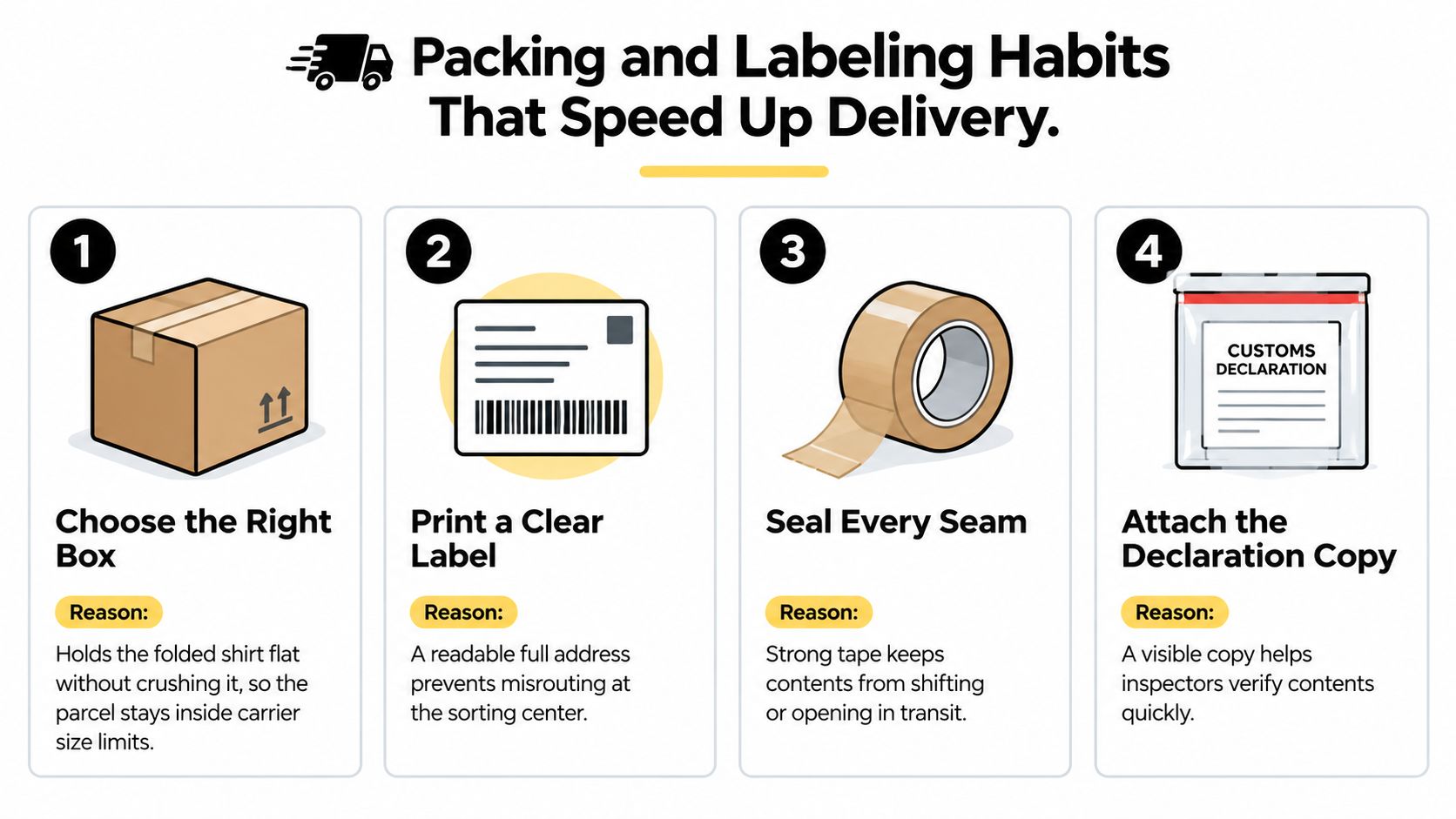
- Choose a close-fitting box. Fold the shirt so it lies flat without crushing the crest or sharply bending decorative elements. Avoid an oversized box that needs unnecessary filling and creates a larger parcel than the contents require.
- Protect printing with a light inner layer. Use clean tissue or a suitable protective sleeve to separate vulnerable surfaces. Keep adhesive tape away from the fabric, badges and printed names.
- Print the complete destination address. Include the apartment or unit, postal code and the recipient's contact number in the carrier's designated fields. Keep the label flat, away from box seams, and remove obsolete labels when reusing packaging.
- Keep the recipient identity consistent. Use the same recipient name on the shipping label and declaration. A shortened nickname on one document and a different name on another creates an unnecessary question.
- Put a packing slip inside. Include the order reference and an item description so support can identify the order if the external paperwork becomes detached. Avoid adding unnecessary payment or personal information.
- Add a discreet recovery reference. A small order reference and recipient identifier on the box can help reconnect separated records. Don't turn the exterior into a duplicate invoice or advertise collectible contents.
- Seal and inspect the finished package. Tape the opening seams securely without covering barcodes or folding them around corners. Follow the carrier's instructions for attaching customs paperwork or a document pouch.
The visual highlights the main physical checks before handover.
Signed items, presentation packaging and bundled shorts can change the finished parcel. Record a separate packed specification for those combinations rather than recycling the measurements for a shirt-only order.
Tracking Gaps and What to Do When a Parcel Stalls
A pause in tracking doesn't automatically mean a parcel is lost. The shipment may have completed its international transport leg but still be awaiting clearance, handover or a new scan.
Check the carrier's own tracking page as well as the retailer's order page. The carrier may display a customs request or local delivery reference that hasn't yet reached the retailer's tracking feed.
A stalled status can be worrying, but the next action should follow the actual tracking message.
Tracking symptoms, likely causes and next actions
| Tracking shows | Likely cause | Next action |
|---|---|---|
| No scans for several days after export | Movement between networks or consolidated transport | Allow the carrier's stated window before escalating |
| Held or customs clearance pending | Customs review or missing declaration data | Respond to a verified request with the invoice and precise description |
| Delivered scan, parcel not received | Alternative handover location or delivery error | Check neighbors and the local post office, then request proof of delivery |
| Tracking stops at the U.S. port | Missing final-mile handover scan | Ask for the last physical scan and domestic tracking reference |
| Return-to-sender notice | Address, declaration or another delivery exception | Contact retailer support with the order reference and evidence |
Gather evidence before opening a case
Send support a complete record rather than only a screenshot saying the parcel is late. Useful evidence includes:
- Order identification: Order number and invoice or confirmation.
- Tracking history: Tracking number, last scan date and displayed status.
- Address record: The delivery address exactly as entered at checkout.
- Physical evidence: Packaging photographs if available, plus any customs or delivery notice.
Wait until the carrier's stated delivery window has passed before treating an ordinary scan gap as a missing-parcel case. Don't wait to answer a document request, verify an unexpected delivered scan or report a return notice.
For an additional visual reference, the following shipping video is available.
Check the order's refund and guarantee terms before assuming they cover a lost parcel. A product satisfaction promise isn't necessarily the same as transit insurance or a carrier investigation policy.
Confirm Costs and Order Dates Before You Buy
The safest international shipping decision combines a delivery deadline with a written landed-cost estimate. Neither the cheapest shipping option nor the shortest advertised transit window tells you the complete purchase cost.
Complete this checklist before authorizing payment:
- Destination: Confirm the country, postal code, unit number and address type.
- Import-payment responsibility: Establish whether the seller prepays duties or the recipient must pay.
- Full total: Add the product price, quoted shipping charge, applicable import charges and any separate handling fee.
- Service comparison: Record the shipping charge and delivery estimate for each available option.
- Unresolved charges: Ask which import costs remain estimates and who will calculate the final amount.
- Dispatch readiness: Confirm whether the item is ready to ship or needs preparation before collection.
Count backward from the occasion
Use this planning formula:
Latest planning order date = event date minus the longest quoted transit time minus dispatch preparation time minus a customs contingency.
For a birthday gift needed on a fixed date, mark that date on a calendar. Count backward by the longest transit estimate quoted for the selected service, then by the seller's preparation period, and finally allow additional time for a customs hold.
Use business days where the service quote uses business days. If the resulting deadline has passed, choose a faster eligible service or change the gift plan rather than assuming the shortest estimate will happen.
Leave room for a delay you can't solve by paying for faster transport after dispatch.
An express upgrade may increase the shipping charge without removing import duties. Compare each option's full landed total, and don't assume that a payment wallet, card or installment method changes customs treatment.
Keep the checkout estimate, order confirmation and delivery terms together. They give you a clear record of what was quoted, what was included and which questions still need answering.
Mystershirt offers authentic football shirt mystery boxes, including Premium, Retro, Kids and sharing options for collectors and gift buyers. Visit Mystershirt, check the delivery estimate for your country and chosen shirt type, and confirm duty-payment responsibility before placing your order. Keep the order record so you're ready if the carrier or customs asks for details.