The most common advice about a men's mystery clothing box is to focus on the reveal: pick a box, wait for delivery, and enjoy the surprise. That's only half the decision. Because you can't try the shirt before buying, fit and seller trust matter just as much as the unboxing. A little preparation can reduce predictable disappointment without giving away which shirt you'll receive.
Table of Contents
- What a Men's Mystery Clothing Box Really Gives You
- Size Chart to Check Before You Order a Mystery Box
- Mystery Box Types and Which One Fits Your Purpose
- Authenticity Checks and Whether the Value Holds Up
- Returns, Guarantees and Delivery Expectations
- How to Order and Confirm Your Mystery Shirt Box
What a Men's Mystery Clothing Box Really Gives You
A men's mystery clothing box is like a tasting menu: you choose the kitchen and the portion size, not each dish. In this case, you select a box type and size, and may be able to list clubs, leagues, or colors you'd rather avoid. The exact shirt stays hidden until it arrives.
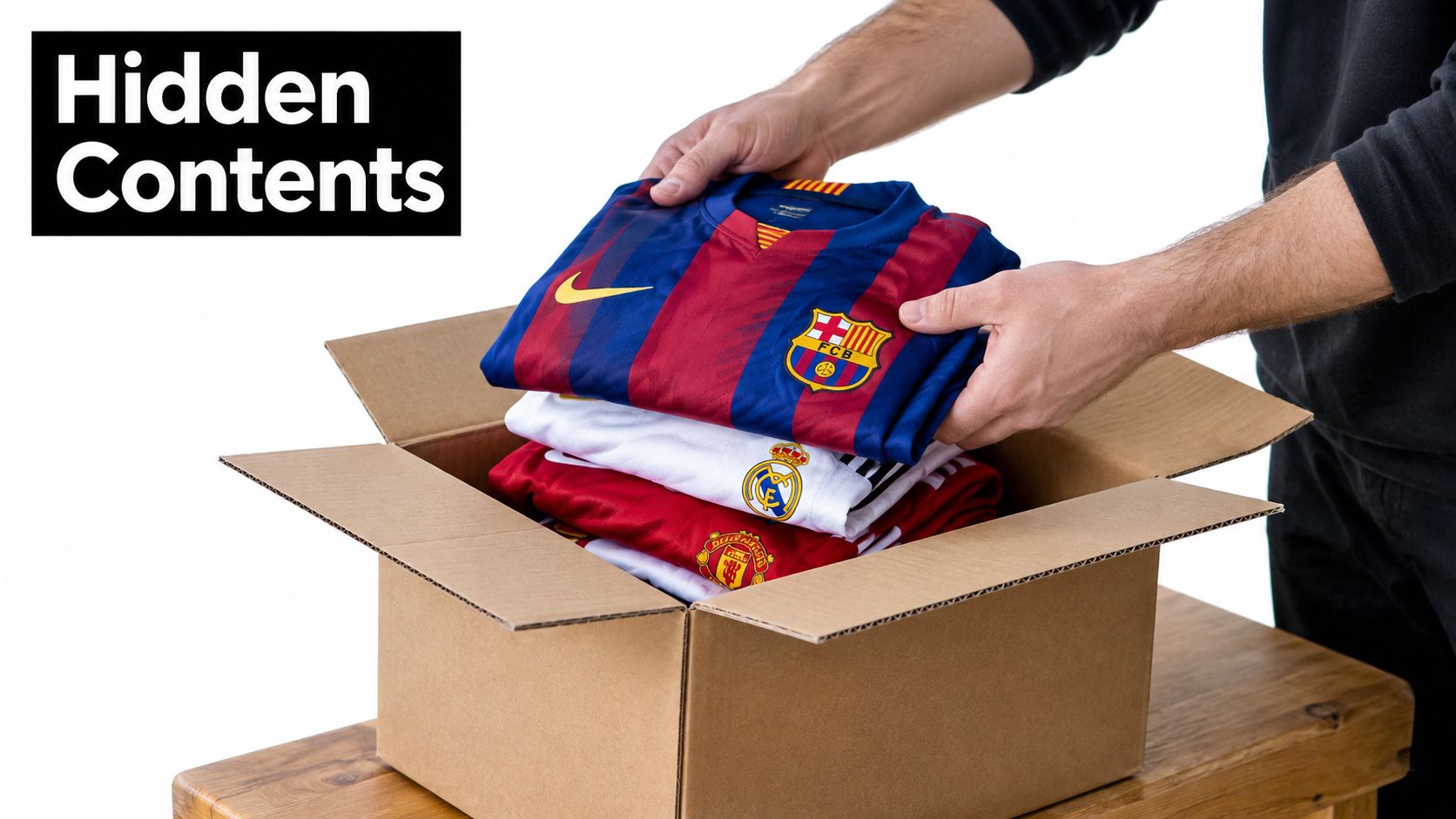
That format trades some choice for discovery. You might receive a club shirt you wouldn't have searched for yourself, or a design from a season you've never followed. The fixed price can make trying something new feel more accessible, but you have less control than you would when buying a named shirt.
Your main controls are fit and exclusions. You can provide useful sizing information and rule out some teams or colors, but you can't inspect the shirt on your body before it ships. That makes a mystery box clothing purchase a fit-and-trust decision, not just an unboxing thrill.
Mystershirt offers Premium, Retro, Kids, Sharing, and signed-item or shorts options, with listed prices starting at $33.32. The practical approach is to check sizing first, then compare box formats, think through authenticity and value, review return and delivery terms, and confirm the order details before paying. The surprise can stay intact while you take care of the risks you can control.
Size Chart to Check Before You Order a Mystery Box
A size label can make a mystery shirt feel predictable, but it does not guarantee a familiar fit. Football shirts vary by brand, season, and cut, so there is no universal chart that can reliably map every chest measurement to S, M, or XL. Use the seller's chart for the specific shirt type when available, and compare it with a shirt you already find comfortable.
A fit preference can also affect whether a purchase works for you. Research on apparel fit and returns discusses size, cut, and shape as factors in fit decisions, without giving a dependable size conversion for mystery shirts. The study on apparel fit and returns supports a practical approach: share measurements and the fit you want, rather than relying on a letter alone.
Measure your chest and a shirt you already like
Measure around the fullest part of your chest, keeping the tape level. This is a body measurement. Then lay a shirt that fits well flat and measure across it from one underarm seam to the other. That garment measurement is called pit-to-pit.
For length, measure the shirt itself from the highest point of the shoulder near the collar to the hem. This is a garment-length measurement, not a measurement of your body. Check how the seller defines each measurement before comparing: chest circumference goes around the body, while pit-to-pit measures a flat garment. They cannot be compared directly. This football shirt sizing chart guide explains garment measurements and can help you interpret a chart.
Use your well-fitting shirt as a reference, not as a guarantee that another shirt will match. Fabric stretch and construction can change how a garment feels, and a different cut can fit differently even when the label is identical.
Choose the fit you want, not just the label
Say your chest measures 104 cm. That figure alone does not establish whether L or XL is right, because brands and shirt styles use different proportions. Compare your measurements with the supplier's chart, then decide whether you prefer a closer or looser fit. If the seller does not provide garment measurements, ask before ordering or recognize that the fit is less certain.
Football shirts can also differ by style. Replica, player, goalkeeper, retro, and youth shirts may sit differently on the body, even when their printed sizes appear similar. A player-style shirt may feel closer-fitting than a replica, while a retro shirt may use a different shape or fabric from a current design. Check a chart for the relevant style rather than assuming that your usual size transfers unchanged.
Before ordering, give the seller the details it can use: chest measurement, height, preferred fit (slim, regular, or oversized), and clubs or colors to exclude. Measurements help reduce fit uncertainty, while exclusions help avoid predictable mismatches. The shirt itself can still be a surprise.
Mystery Box Types and Which One Fits Your Purpose
| Box format | Best for | What it contains | Starting price |
|---|---|---|---|
| Premium Mystery Box | Collectors wanting current-tier shirts | Premium-tier football shirts | Check the current listing |
| Retro Mystery Box | Fans collecting older eras and designs | Retro-era football shirts | Check the current listing |
| Kids Mystery Box | Parents buying for children | Children's sizes and designs | Check the current listing |
| Sharing Box | Friends, teammates, and groups | Several shirts split among a group | Check the current listing |
| Signed items and shorts | Gift buyers wanting one recognisable item | Signed shirts and matching shorts | Check the current listing |
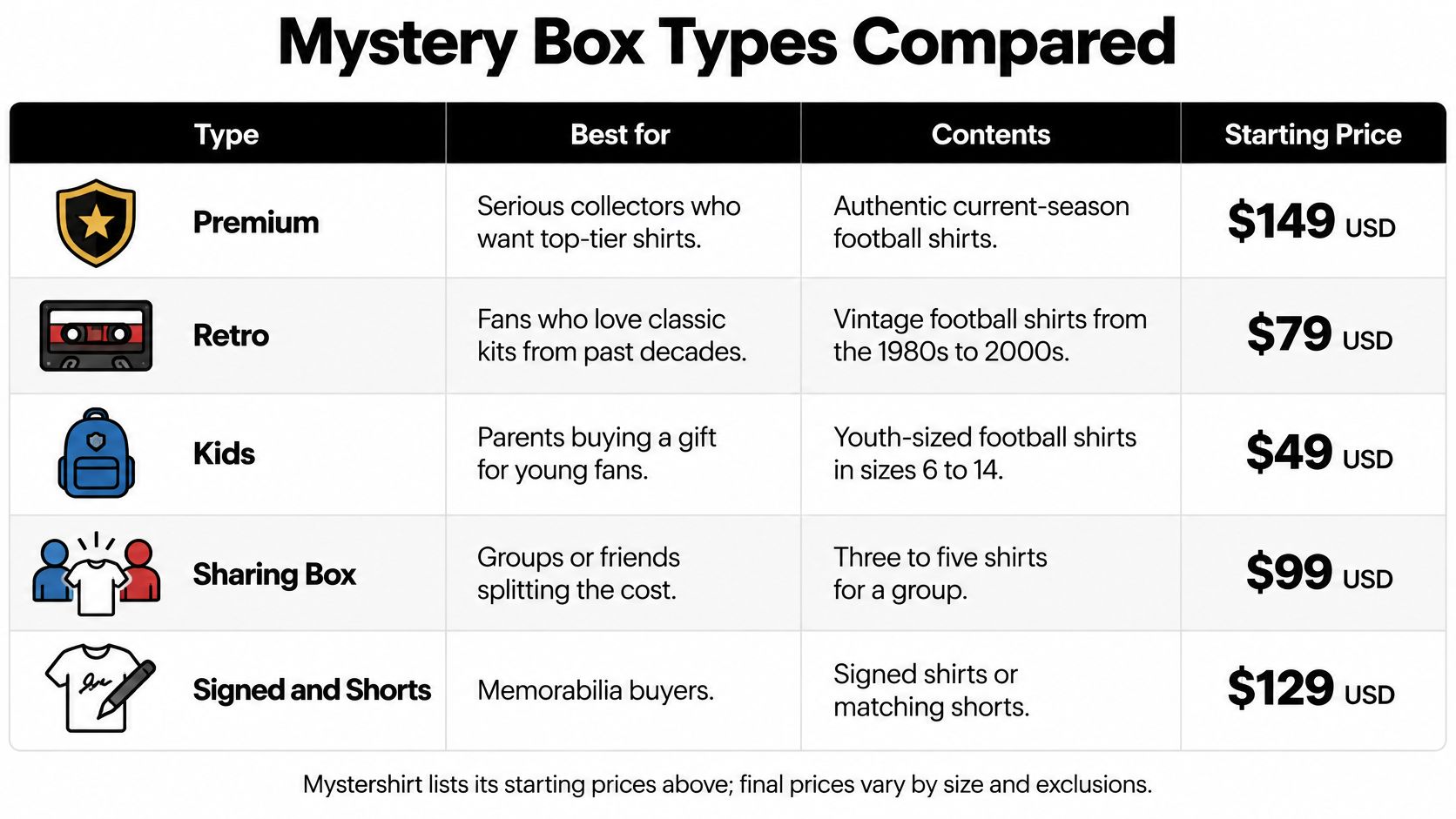
Mystershirt lists a starting price of $33.32, and offers Premium, Retro, Kids, Sharing, and bundle options. Check the individual product page for the current price and contents before you order, since format, size, and exclusions can affect what's available.
A Premium box makes sense for a collector who wants a higher-tier shirt from a recent season. Choose Retro if your interest is in older designs and the history behind them. In either case, decide whether your priority is a particular era or club, or the chance to discover something outside your usual collection.
A Kids box is for young fans, but a parent should confirm the child's measurements and select a children's size rather than guessing from age alone. A shirt that fits a child now may not fit for long, so check the size details and return terms before placing a gift order.
A Sharing Box works for friends or teammates who want to split the experience and the cost. Agree on exclusions as a group before ordering. If one person strongly dislikes a particular club or color, settle that preference in advance rather than trying to negotiate after the shirts arrive.
For a birthday gift, a signed item or shorts may feel more recognisable than a mystery shirt. If the recipient supports one club and wouldn't wear a rival's shirt, the exclusion list may matter more than whether you choose a higher box tier. Keep the surprise about the specific item, not about whether the gift suits the person at all.
Authenticity Checks and Whether the Value Holds Up
A shirt can feel right, carry familiar branding, and still leave unanswered questions about its origin. Authenticity is a trust question, while value also depends on condition and whether you would wear or collect the item. A few checks can reduce predictable disappointment without taking the surprise out of the box.
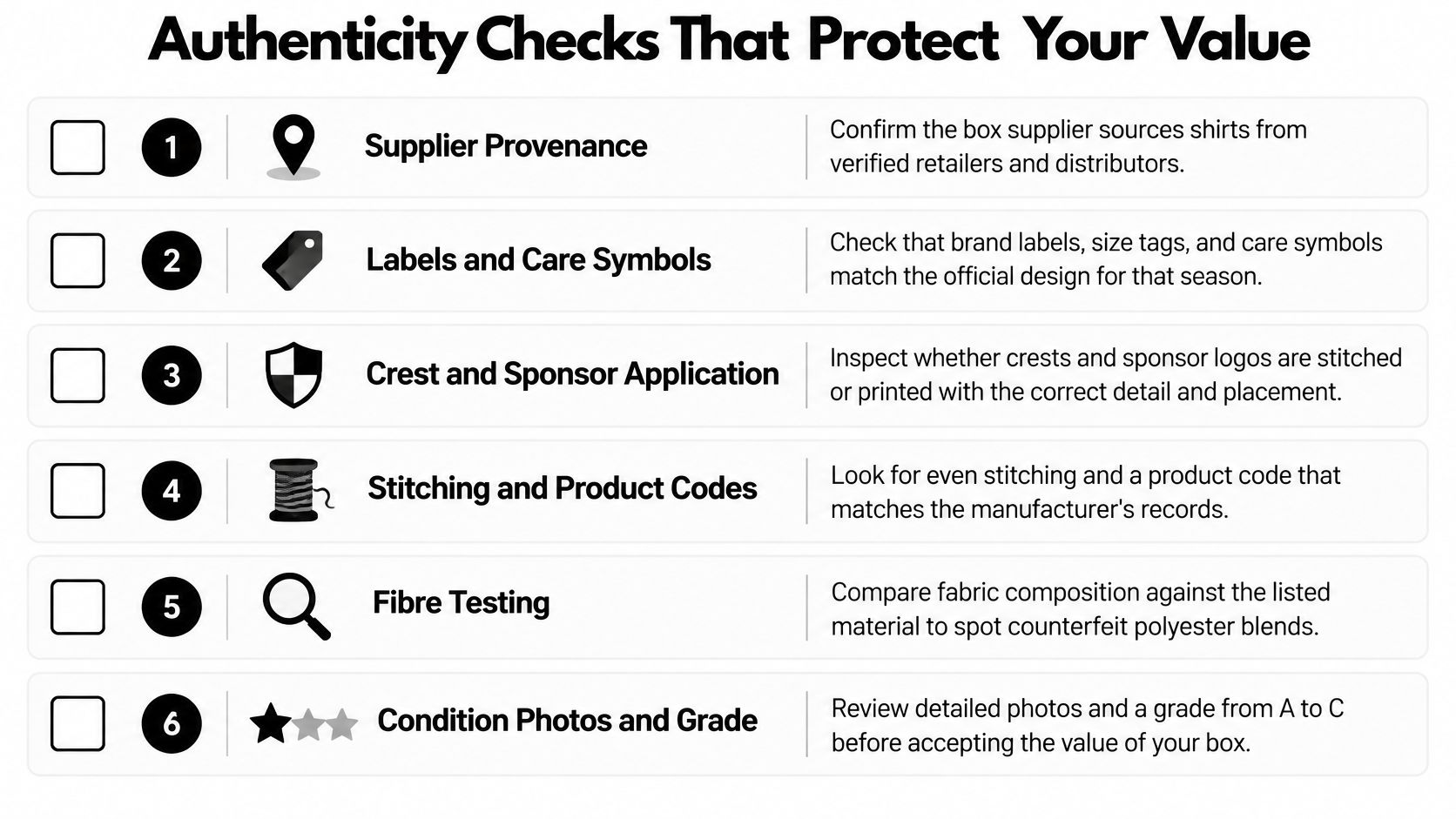
| Check | What it can show | What it cannot establish alone |
|---|---|---|
| Supplier provenance and purchase records | Where the stock came from | The condition of each garment |
| Labels, care symbols, crest and sponsor application | Whether construction matches a documented season design | Brand approval |
| Stitching and product codes | Whether details are consistent with known designs | Where the fibre was made |
| Fibre testing, such as infrared or solubility analysis | Whether the generic textile composition is plausible | Brand or club origin |
| Condition grade and photographs | Wearability and traceability | Authenticity |
Start with provenance, then inspect the shirt
Ask where the seller's stock comes from and whether purchase records or other evidence of provenance are available. Then examine the labels, care symbols, crest, and sponsor application. Compare their placement and construction with documented examples from the relevant season. Like checking a signature alongside its paperwork, several matching details make a stronger case than one familiar-looking logo.
Stitching and product codes add clues when they are present, but they do not replace documentation. Use this guide to checking football shirt authenticity to learn which features to examine and compare.
Treat material tests as supporting evidence
ASTM's guidance identifies microscopy, solubility relationships, and infrared spectroscopy as methods for identifying textile fibres. For man-made fibres, infrared analysis and solubility testing are preferred approaches. However, these tests generally cannot distinguish between manufacturers using the same generic fibre class. ASTM also cautions against relying on them alone for commercial acceptance because the results are qualitative and limited. ASTM's textile fiber identification guidance explains why fibre composition and garment authenticity need separate checks.
For value, weigh authenticity, condition, season, scarcity, wearability, and likely resale rather than judging only by the shirt's original retail price. A short-run retro shirt from a less common season might interest a collector more than a current replica, even if both arrive in boxes at the same price. An older shirt is not automatically valuable. Its appeal depends on what you want and whether its condition suits how you plan to use it.
Before buying, ask the seller three direct questions: Where did the stock come from? Are items photographed and graded? Can I return a shirt that isn't as described? Clear answers help you assess trust and value while keeping the specific item a surprise.
Returns, Guarantees and Delivery Expectations
A mystery box can arrive on time and still disappoint if the fit is wrong or the return terms are unclear. Check the seller's policy before ordering, especially what counts as a returnable item, the required condition, and how soon you must act.
| Item | Published term |
|---|---|
| Starting price | From $33.32 |
| Money-back guarantee | 100 days |
| Express delivery in Europe | 1–4 days |
| Global shipping | 1–30 days |
| Payment options | Apple Pay, Google Pay, PayPal, major cards, Shop Pay, Klarna pay later |
Mystershirt lists a 100-day money-back guarantee, with delivery estimates of 1–4 days for express delivery in Europe and 1–30 days for global shipping. Its listed starting price is $33.32. Treat these as published terms to verify for your specific order and destination, not as a promise that every parcel will arrive within the shortest estimate. Review Mystershirt's returns and refunds policy before buying.
Fit is a common source of return requests. A benchmark summary reports that approximately 24.4% of U.S. online apparel orders are returned, and that size and fit are the top reason identified by 53% of apparel decision-makers. The apparel returns and conversion benchmark summary helps explain why clear sizing guidance matters even when the exact shirt remains a surprise.
If the shirt doesn't fit, follow the policy's requirements and contact the store promptly. A shirt that fits but isn't your style may be treated differently, so check whether the terms cover changes of preference as well as sizing issues. Confirm the deadline and condition rules, then photograph the shirt on arrival and keep its tags and packaging while you decide.
Before the reveal: Read the return terms before the box arrives, so you know what to do if the shirt isn't right.
For a gift, plan around the longest delivery window that applies to the destination. That leaves room for the parcel to arrive later than the earliest estimate.
How to Order and Confirm Your Mystery Shirt Box
A mystery shirt is a fit-and-trust decision as much as a surprise. You can't choose the exact shirt, but you can check the measurements, set useful preferences, and confirm what you're buying before checkout. That keeps room for discovery while reducing predictable disappointment.
Follow the order steps
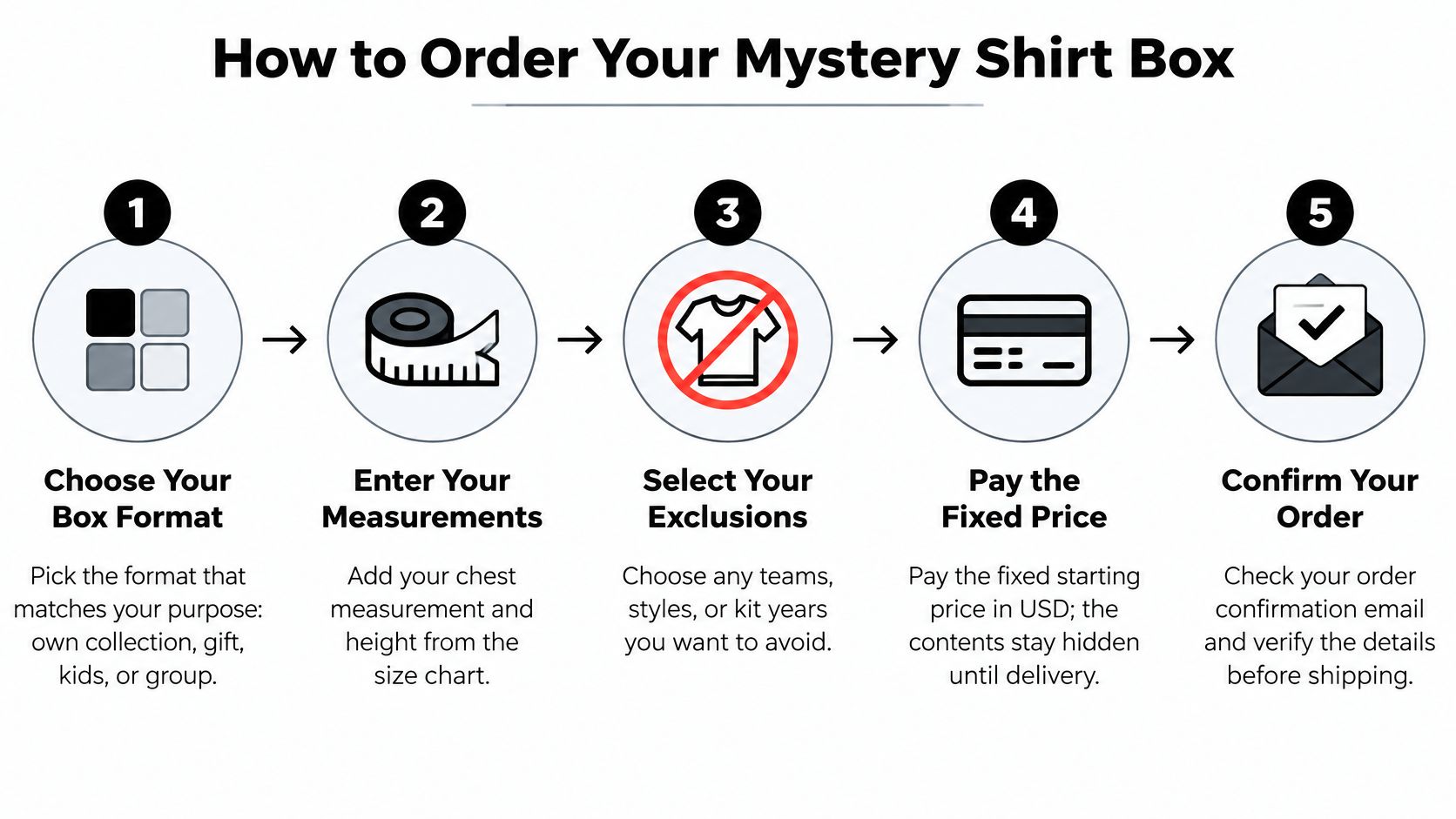
- Choose the box format. Pick one for your collection, a gift, a child, or a group. A collector might prefer a Premium or Retro option, while friends ordering together could choose a Sharing Box. The format should match who will wear the shirt and why.
- Enter your measurements. Use chest measurement and height instead of relying on your usual size label. Compare them with the seller's chart, including the shirt's body length. A shirt can fit across the chest yet feel too short or long.
- Select your preferred fit. If the form offers slim, regular, or oversized, choose the cut you actually like. This gives the seller more useful guidance than a size alone.
- List exclusions. Name clubs, leagues, or colors you would rather avoid. Keep the list focused: excluding too many choices can leave less room to match your preferences while preserving the surprise.
- Check the chart against product details. Look for the brand's sizing information and compare it with a shirt you already wear comfortably. Shirt cuts can differ by season, so matching labels do not always mean matching fit.
- Choose a payment method. Options include Apple Pay, Google Pay, PayPal, major cards, Shop Pay, and Klarna pay later. Check the payment details and total before completing checkout.
- Confirm delivery region and timing. Review the estimate for your destination. For a gift, plan around the longest stated delivery window rather than counting on the earliest estimate.
A few choices can make the result harder to wear: sizing by label alone, selecting an adult size for a child, or leaving a group's exclusions undecided. You also do not need to rule out a whole league because of a few clubs you dislike. Specific preferences leave more room for an unexpected shirt you might enjoy.
After checkout, read the confirmation and make sure it reflects the format, size, and exclusions you intended. Contact the store promptly if anything is wrong. When the shirt arrives, check its condition and measurements before removing or discarding packaging, in case you need to raise an issue.
It also helps to decide what you would do if the shirt is not one you want to keep. You could wear it, give it to someone who supports the club, swap it with a friend, resell it, or donate it. A discounted shirt still costs money if it stays unworn, so consider repeat wear and how long the product is likely to last, not just the fun of the reveal.
Before paying, check these points:
- Measurements: You chose a size using measurements, not the label alone.
- Exclusions: Your list is specific without ruling out most choices.
- Purpose: The box format fits the intended wearer.
- After arrival: You have considered whether to wear, gift, swap, resell, or donate the shirt.
A good surprise leaves room for discovery while protecting the buyer from problems they could have prevented.
Mystershirt offers Premium, Retro, Kids, Sharing, and special-item football shirt mystery boxes, with size and exclusion choices to help manage fit and style preferences. Before ordering, review the measurements, delivery estimate, and guarantee terms, then choose a box format and enter fit preferences at Mystershirt.