A 1927–28 Newcastle United shirt was estimated at £3,500–£5,000 by Budd Auctions in 2025. That's a useful reminder that Newcastle retro shirts aren't all the same kind of purchase. A rare period garment, an officially licensed remake and a mystery-box shirt can serve completely different purposes.
The best choice starts with what you want to own: a piece of football history, a recognisable shirt to wear or a surprise for someone who loves the game. Understanding those differences matters more than finding a listing with “authentic” in its title.
Table of Contents
- Newcastle Retro Shirts by Era and Milestone
- Why the 1995–97 Shirt Remains the Benchmark
- Choosing Between Originals and Official Retro Shirts
- How to Check a Newcastle Shirt Is Genuine
- Is a Retro Mystery Box Right for You
- Choose Your Shirt and Buy With Confidence
Newcastle Retro Shirts by Era and Milestone
| Era | Defining feature | Reference point | Suits |
|---|---|---|---|
| 1894–1910 striped kit | Black-and-white stripes adopted in 1894 | 1908 league championship | Historical collectors |
| 1910–1911 cup-final designs | City coat of arms on shirts | 1910 and 1911 FA Cup finals | Cup-final collectors |
| 1995–97 Entertainers shirt | Broad stripes, grandad collar, Newcastle Brown Ale sponsor | Premier League runners-up in 1995–96 and 1996–97 | Buyers seeking the recognisable modern classic |
| adidas era 1995–2010 | adidas supplied the kit | Start and end of the manufacturer's original supply run | Buyers collecting by manufacturer |
| 2025 official remake | Recreated Entertainers home design, with optional Shearer or Ginola printing | Official modern relaunch | Officially licensed wearers |
Read the era as history, not proof of age
According to Newcastle United's kit history, the club adopted black-and-white stripes in 1894, following the 1892 merger of Newcastle East End and Newcastle West End. The same history records three league titles in five seasons, culminating in 1908, and the city coat of arms appearing for the 1910 FA Cup final, with a related version used in 1911.
Those milestones explain why the stripes matter beyond their appearance. A modern recreation can connect its wearer with the club's early identity without being an early garment itself. The dates describe the design's historical reference point, not necessarily when the shirt in a seller's photograph was manufactured.
The auction estimate at the opening belongs to the specialist end of collecting. It isn't a price guide for every striped shirt, and an estimate isn't a confirmed sale price. A seller offering an ordinary retail shirt shouldn't use the existence of rare early pieces as evidence that theirs deserves a similar premium.
Buying perspective: Choose the historical story you like first, then decide whether you need the original object that carries it.
Match the era to your purpose
For wearing, prioritise fit, comfortable fabric and a sponsor that isn't deteriorating. For gifting, recognisability and a clear product description are more useful than uncertain claims about rarity. Collectors should narrow their search to a specific design and production version before comparing listings.
If your interest extends beyond Newcastle, this guide to football shirts from the nineties offers a broader starting point for exploring the period's appeal.
Player stories also help explain why particular shirts become meaningful. For a contemporary comparison, Fubo News examines how Pulisic's new deal shapes his future. It's a useful companion read if you enjoy connecting football clothing with the careers and expectations surrounding its wearers.
Why the 1995–97 Shirt Remains the Benchmark
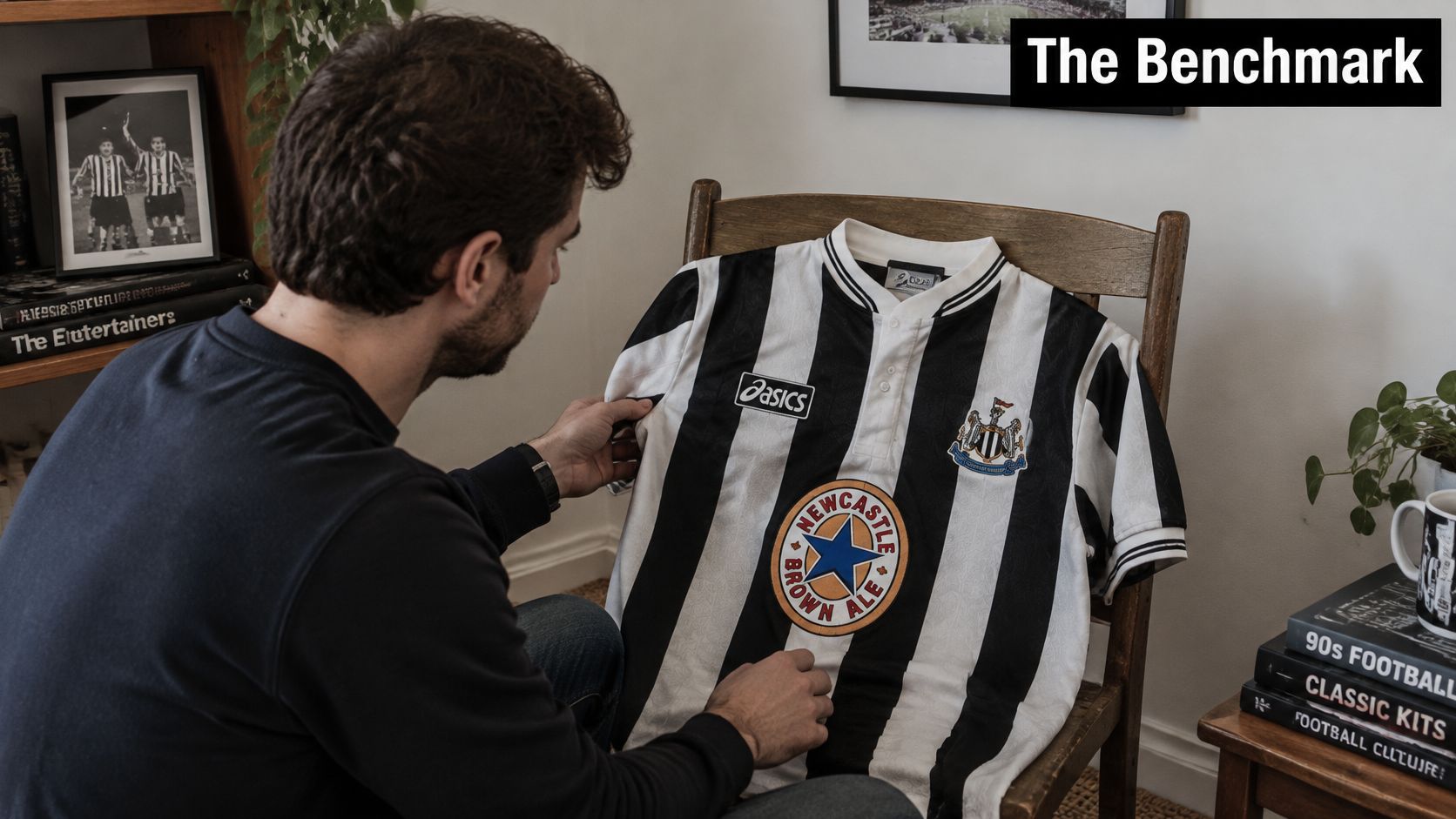
The Entertainers home shirt combines a distinctive design with a memorable team. In its official relaunch announcement, Newcastle connects the 1995–97 shirt with Kevin Keegan's side, which finished Premier League runners-up in 1995–96 and 1996–97, and players including Alan Shearer, David Ginola, Les Ferdinand, Peter Beardsley and Philippe Albert.
The sponsor is an important part of that visual identity.
What the design gives a buyer
The silhouette is distinctive. Broad stripes and a button-up, grandad-style collar give the shirt a recognisable shape even before you inspect the crest. For a wearer, that makes the design easy to appreciate without knowing every detail of the team's history.
The sponsor provides a useful comparison point. The Newcastle Brown Ale logo isn't incidental decoration. When checking an original, examine its shape, positioning and application rather than accepting any broadly similar circular logo as correct.
A clear front photograph helps establish the overall design, but it won't establish the shirt's age. A reproduction can reproduce the same visual features. Ask for close-ups that show how the sponsor sits on the fabric and whether the surrounding material has comparable wear.
For moving-image context alongside the shirt's design, watch the video below.
Printing adds meaning, not provenance
Newcastle's relaunch announcement records the January 2025 remake with optional Shearer number 9 and Ginola number 14 printing. It also places the original within adidas's 1995–2010 supply relationship with the club.
For a gift, choosing a player the recipient admires can make the shirt more personal. For a collector, however, the name on the back raises another question: was that printing applied during the shirt's original retail life, or added later?
- Inspect the lettering separately. A genuine shirt doesn't automatically make every later addition period-correct.
- Distinguish personal appeal from evidence. A favourite player's name can make a shirt more desirable to you without proving match use.
- Choose deliberately. A blank back may suit someone who prefers the design itself over a particular player association.
The shirt works because buyers can enjoy both its appearance and its football story. You don't need an original to enjoy those qualities, but you do need accurate information if originality is what you're paying for.
Choosing Between Originals and Official Retro Shirts
| Option | Age and origin | Labels and sponsor | Typical price | Best use |
|---|---|---|---|---|
| Original vintage | Manufactured during the design's original period | Period-appropriate labels and application methods | Assess against comparable originals and condition | Collecting |
| Official retro reproduction | Modern licensed recreation of an earlier design | Modern production labels with recreated graphics | Compare current licensed retail listings | Wearing and gifting |
| Unlicensed replica or counterfeit | Unauthorised copy, sometimes misrepresented as genuine | Details may imitate originals or contain inconsistencies | A low asking price doesn't establish value | Avoid for authenticity-led collecting |
The most important distinction is when and under whose authority the garment was made. A vintage original is a garment produced in its own period. An official retro shirt is a newly manufactured, authorised recreation, not an old shirt recovered from storage.
The Newcastle retro-shirt buying guide identifies official recreations of the 1984, 1990 and adidas 1995–97 designs. Their existence illustrates the central buying trap: historically familiar styling doesn't establish historical manufacture.
Why the remake can be the better purchase
An officially licensed reproduction is often the more straightforward choice for someone who wants to wear the design or give it as a present. You can choose it for its appearance without needing to preserve a fragile period sponsor or explain an uncertain ownership history.
That doesn't make every original unsuitable for wearing. It means the original's condition becomes part of your decision. Inspect pulls, holes, repairs, discolouration and lifting graphics, then decide which imperfections you're willing to live with.
A shirt can be officially licensed and newly made. It can also be genuinely old without being match-worn.
Build an evidence file before paying
For remote buyers, especially those outside the UK who can't inspect a specialist shop's stock, photographs become the main evidence. Request clear images of the neck label, internal care labels, crest, sponsor, seams and any back printing.
- Confirm the specification. Ask whether the seller means retail replica, player issue or match-worn. These aren't interchangeable descriptions.
- Get measurements. Compare pit-to-pit width and back length with a shirt that already fits, rather than relying only on the size letter.
- Keep the listing. Save the description and photographs, and use a return policy where construction or provenance remains uncertain.
In football-shirt terminology, retail replica can describe a legitimate licensed supporter shirt. It doesn't automatically mean counterfeit. Buy an original when the evidence supports it and the condition suits you; otherwise, an official recreation is a sensible purchase, not a compromise.
How to Check a Newcastle Shirt Is Genuine
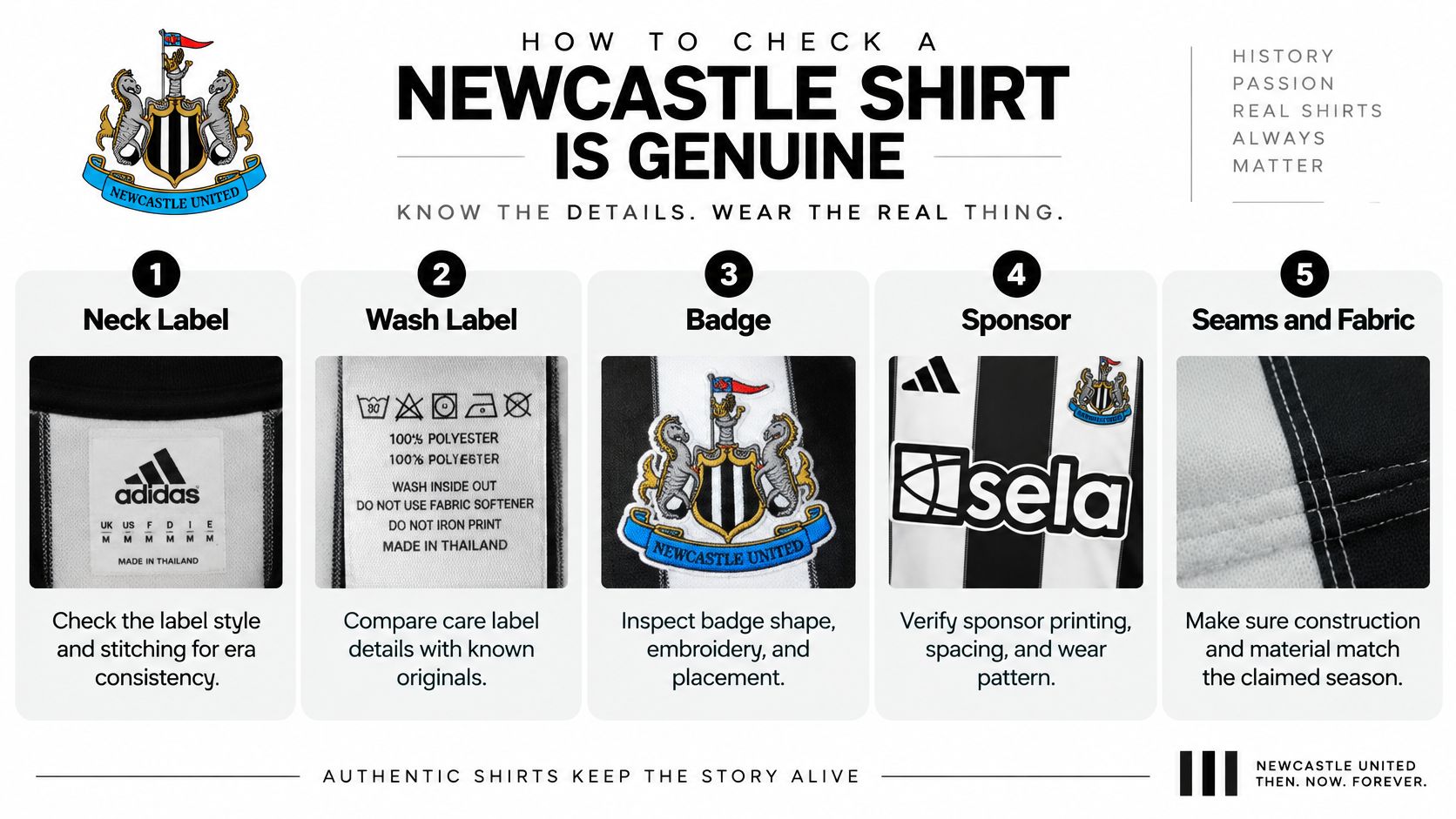
Authentication is a consistency test. The neck label, care label, crest, sponsor and construction should support the same explanation of what the shirt is. A convincing badge can't cancel out contradictory internal labels.
Use Historical Football Kits' Newcastle change-kit archive to compare the claimed version, including the club's yellow-and-green combinations, blue-trimmed shirts and experimental nineties patterns. Don't authenticate an away shirt against a home-shirt photograph based solely on both carrying the same manufacturer's logo.
The visual checklist highlights the main inspection areas.
Inspect from the inside out
- Start with the neck label. Compare typography, spacing, label material and the way it's attached with a reliable example of the claimed manufacturer and season. Formatting from a different production period needs an explanation.
- Read the wash label. Examine the language, care symbols and fibre declaration, not just the brand name. Wording or symbols that don't fit the claimed period deserve further investigation.
- Check origin information and product coding. Record the information exactly before comparing it with known examples. A missing code isn't a universal counterfeit verdict, but an implausible code shouldn't be ignored.
- Identify the badge technique. Look closely enough to distinguish embroidery, felt or flock, heat application, sublimation and graphics integrated into the fabric. Ask whether that method belongs on the particular version being sold.
- Examine the sponsor and seams together. Check the sponsor's edges, texture and application, then inspect the stitching around the body and sleeves. Modern-looking transfer graphics on a claimed vintage garment need scrutiny, though heat application alone doesn't prove a fake.
- Finish with collar, hem and fabric. Inspect collar joins, hem width, stretch and surface texture. An implausible fibre declaration or construction that contradicts the comparison shirt should reduce your confidence.
Judge the whole garment
Wear isn't proof of age, and pristine condition isn't proof of a reproduction. A convincing conclusion comes from details agreeing with each other, not from one dramatic clue.
Confidence check: If you can explain the label but not the sponsor, the shirt still needs investigation.
For additional photographic checks, use our guide to checking whether a football shirt is authentic. When the evidence remains contradictory, treat the shirt as unresolved rather than upgrading a guess into certainty.
Is a Retro Mystery Box Right for You
A mystery box changes the purchase from choosing a specific shirt to choosing the conditions of a surprise. You select the type of experience and your size, but you don't see the exact shirt before it arrives. That can suit a broad football-shirt collection better than a tightly defined Newcastle search.
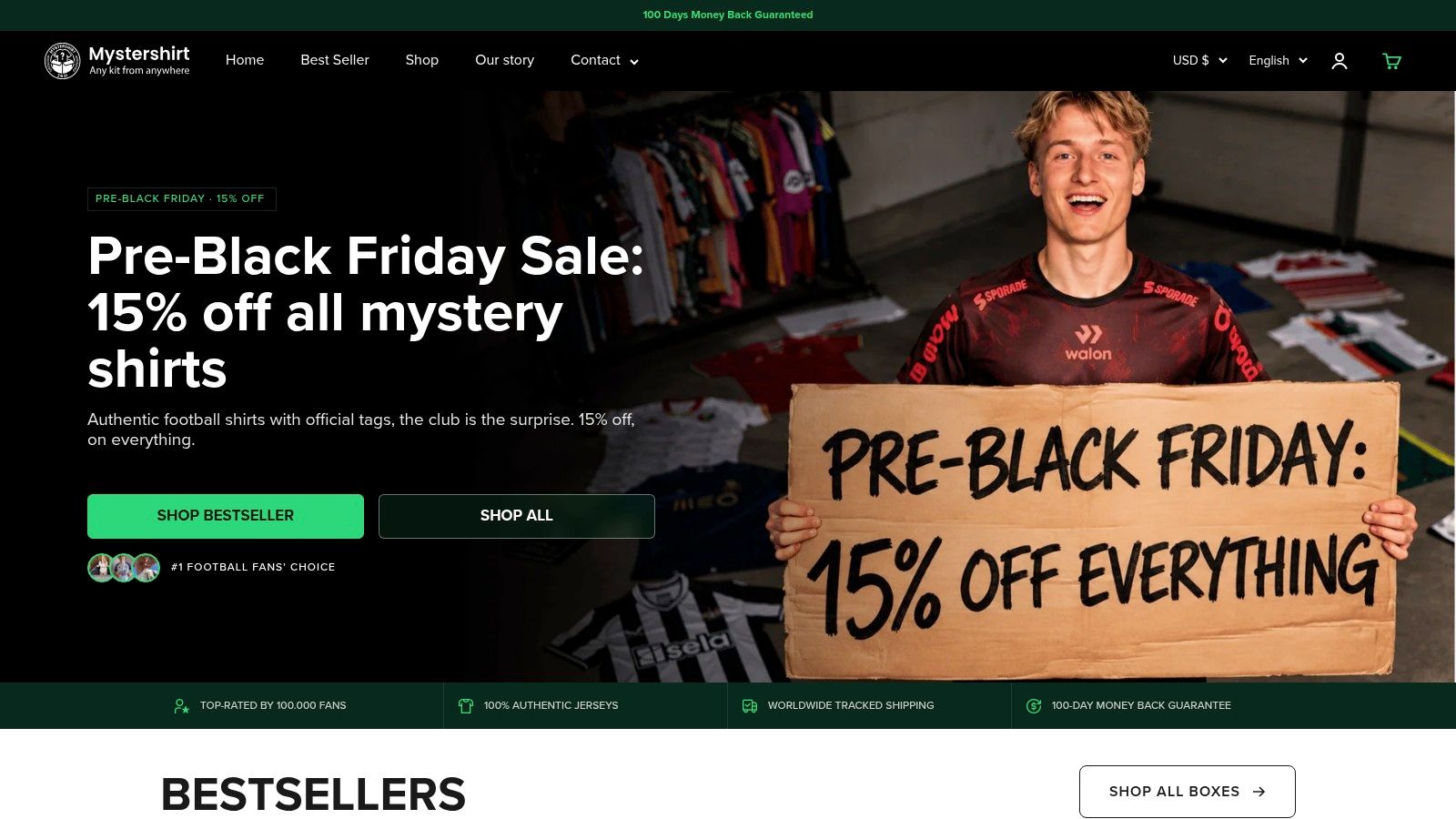
Our Premium Mystery Box and Retro Mystery Box offer different starting points. The Premium Football Shirt Mystery Box costs €44.95 and includes two authentic shirts from recent seasons, in sizes XS–5XL. Sharing and name-and-number options are also available, and customers can list clubs or colours they don't want to receive.
The storefront gives a sense of that shopping format.
What exclusions can and can't do
An exclusion removes an unwanted possibility. It doesn't reserve the club you hope to receive. Leaving Newcastle off your exclusions therefore doesn't guarantee Newcastle, a particular home design or a specific season.
We source official shirts through clubs, official suppliers and verified partners. Every shirt we send is authentic and comes with labels included, and we never put two shirts from the same club in one order. Our approach offers a more sustainable and affordable way to get football shirts while letting customers decide which shirts they don't receive.
- Choose a direct purchase for precision. A recipient who wants a particular Newcastle sponsor, collar or player print needs that named shirt.
- Choose surprise for exploration. A fan who enjoys discovering clubs from around the world may appreciate an unexpected design.
- Separate value from resale expectations. Buy a box for the shirts and experience, not an assumed collectible windfall.
Our football jersey mystery-box guide explains the format in more detail.
Inspect what arrives
Authenticity and historical age are different questions. When the shirt arrives, retain its labels and establish what the garment is before describing it as vintage or offering it for resale.
Compare the labels, badge and sponsor as you would with any purchase. A surprise format doesn't remove the need to understand your shirt, and it can't substitute for buying a named Newcastle design directly.
Choose Your Shirt and Buy With Confidence
The strongest purchase is the one that matches your purpose, not the one with the most exciting listing title. Decide what success looks like before browsing, especially if you're buying for someone else.
Make the decision in order
- Set the goal. Collectors need evidence of period manufacture and an acceptable condition. Wearers need fit and durability. Gift buyers need confidence that the recipient will enjoy what they receive.
- Set the budget and visual reference. Choose whether you're drawn to Newcastle's early striped identity, the Entertainers design or a licensed recreation. Keep the amount you're prepared to spend separate from any unproven suggestion of future value.
- Choose the buying route. Pursue an original only when the photographs and description support the claim. Choose official retro for a specific historical look without requiring a period garment. Choose a mystery purchase only when an unexpected club would still be welcome.
For collectors, the recommendation is restraint: an unresolved shirt is one you can leave behind. For wearers and gift buyers, the authorised recreation removes the need to pay for age you don't want. For surprise-seekers, flexibility is part of the purchase rather than a drawback.
Check fit before committing
A desirable design won't make an uncomfortable shirt enjoyable to wear. Compare actual garment measurements, consider how you'll layer it and make sure you understand the seller's description.
If you're unfamiliar with buying clothing online, The Dressed Man's clothing shopping tips for beginners provides a broader starting point for making deliberate choices.
Write down your goal and budget, then open either an official retro range for a named Newcastle shirt or a mystery-box page for a surprise, and choose your size.
Mystershirt offers authentic football-shirt mystery boxes for fans who enjoy discovering an unexpected club or design. If that flexibility suits you better than a guaranteed Newcastle shirt, visit Mystershirt, choose your box and size, and list the clubs or colours you don't want to receive.